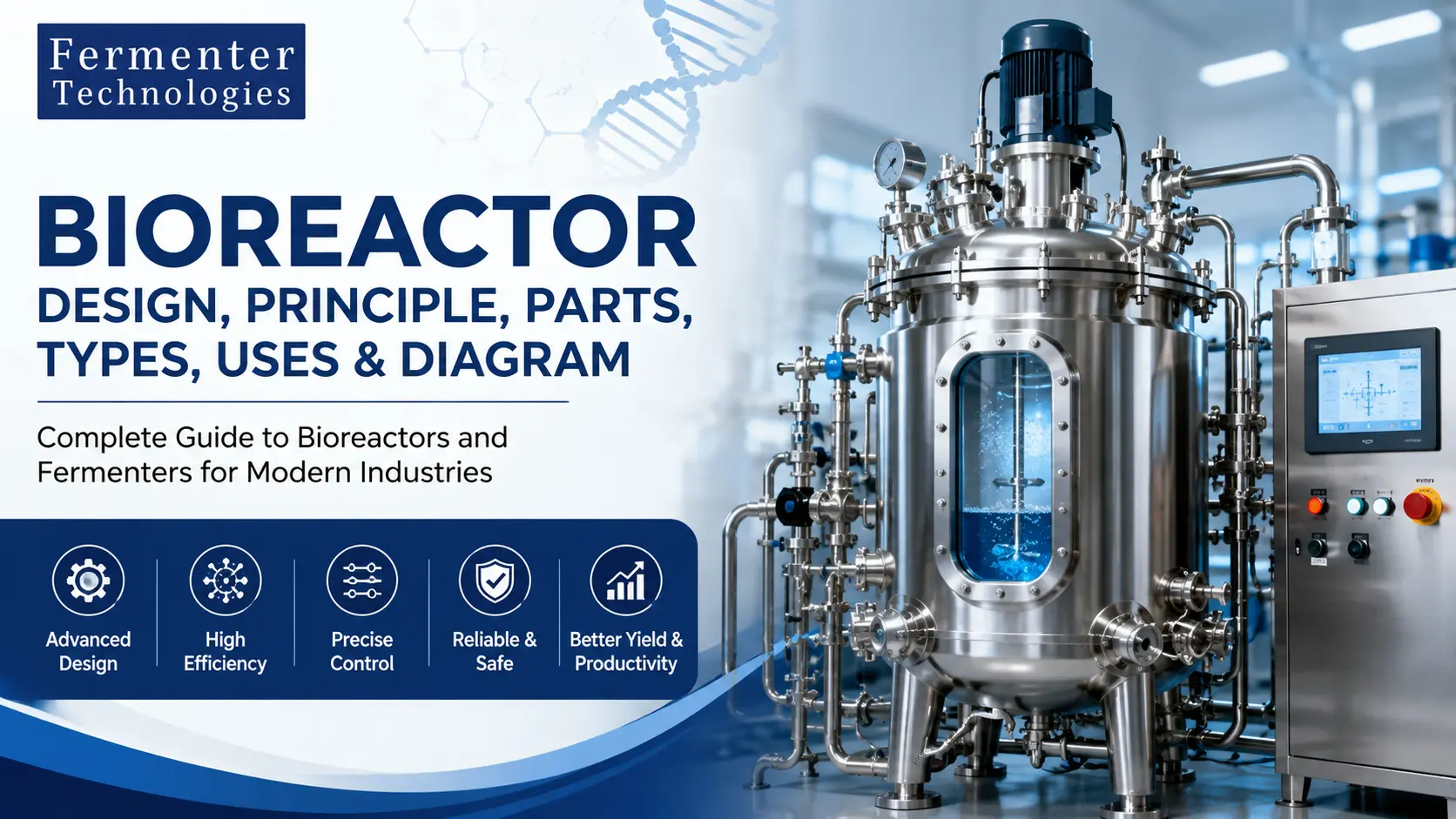
Biotechnology has become one of the fastest-growing industries in the world, driving innovations in pharmaceuticals, food processing, agriculture, environmental engineering, and biofuel production. At the center of these biological manufacturing processes is one of the most important pieces of equipment—the bioreactor. Whether producing life-saving vaccines, antibiotics, industrial enzymes, probiotics, or biofertilizers, bioreactors create the ideal environment for microorganisms and cells to grow efficiently while maintaining complete process control.
Many professionals entering the biotechnology or fermentation industry often come across terms like fermenter, bioreactor, and fermentor. Although these terms are frequently used interchangeably, they have different meanings depending on the application. Understanding the bioreactor definition, its design, working principle, components, and industrial applications is essential for selecting the right equipment and achieving consistent production results.
In today’s highly competitive manufacturing environment, industries require equipment that not only improves productivity but also ensures product quality, contamination control, and regulatory compliance. Modern bioreactors have evolved far beyond simple fermentation vessels. Equipped with advanced automation systems, intelligent sensors, and precision controls, they enable manufacturers to achieve maximum yield while minimizing operational costs.
In this comprehensive guide, Fermenter Technologies explains everything you need to know about bioreactors, including their working principle, design, major parts, different types, industrial uses, and the role they play in modern biotechnology.
What is a Bioreactor?
A bioreactor is a specially engineered vessel that provides a controlled and sterile environment where biological reactions can take place efficiently. Inside this vessel, microorganisms such as bacteria, yeast, fungi, algae, or cultured plant and animal cells grow under carefully monitored conditions. These organisms consume nutrients supplied through the culture medium and convert them into valuable biological products such as antibiotics, enzymes, vaccines, organic acids, biofertilizers, and many other commercially important compounds.
Unlike ordinary storage tanks, bioreactors continuously monitor critical process parameters such as temperature, pH, dissolved oxygen, agitation speed, foam formation, pressure, and nutrient concentration. Every parameter directly affects cell growth and product quality, making precise control essential for successful production.
Modern industries rely on bioreactors because they provide a highly reproducible environment. Whether manufacturing pharmaceuticals or producing industrial enzymes, maintaining stable process conditions helps achieve higher productivity, better product consistency, and lower contamination risks.
What is a Fermenter?
A fermenter is a specialized type of bioreactor mainly designed for microbial fermentation processes involving bacteria, yeast, or fungi. Its primary objective is to cultivate microorganisms under controlled environmental conditions so they can produce useful products such as ethanol, enzymes, probiotics, antibiotics, amino acids, and biofertilizers.
This often creates confusion between the terms fermenter and bioreactor. In reality, every fermenter can be considered a bioreactor because fermentation itself is a biological process. However, not every bioreactor is a fermenter. Modern bioreactors are capable of supporting much more advanced biological operations, including mammalian cell culture, stem cell research, tissue engineering, vaccine manufacturing, and recombinant protein production.
In simple terms, fermenters focus mainly on microbial fermentation, whereas bioreactors support a much wider range of biological applications.
Working Principle of a Bioreactor
The working principle of a bioreactor is based on providing the most suitable environment for microorganisms or cultured cells to grow and multiply. Every biological process requires precise environmental conditions, and even a slight variation in temperature, oxygen level, or pH can significantly affect production efficiency.
The process begins by sterilizing the reactor using advanced Sterilize-In-Place (SIP) systems. This eliminates unwanted microorganisms that could contaminate the production batch. Once sterilization is complete, a carefully prepared nutrient medium is transferred into the vessel. This medium contains carbohydrates, proteins, minerals, vitamins, and other nutrients required for microbial growth.
After media preparation, selected microorganisms or cultured cells are inoculated into the reactor. An agitator continuously mixes the culture to ensure nutrients remain evenly distributed throughout the vessel. At the same time, sterile compressed air enters through a sparger installed at the bottom of the reactor, providing dissolved oxygen necessary for aerobic microbial growth.
During the entire production cycle, sophisticated sensors continuously monitor important operating parameters. If the temperature increases beyond the desired limit, the cooling jacket automatically removes excess heat. Similarly, if the pH changes, automated dosing pumps add acid or alkali to maintain optimum conditions.
This continuous monitoring and automatic control enable microorganisms to grow under ideal conditions, resulting in maximum productivity and consistent product quality.
Bioreactor Design
An efficient bioreactor design is one of the most critical factors affecting biological production. A poorly designed reactor may lead to insufficient oxygen transfer, uneven nutrient distribution, excessive foaming, or contamination, ultimately reducing production efficiency.
Modern industrial bioreactors are generally manufactured using high-grade SS316L stainless steel because of its excellent corrosion resistance, hygienic properties, and long service life. The vessel is designed with smooth internal surfaces that prevent microbial accumulation and facilitate easy cleaning.
One of the most important objectives of bioreactor design is to ensure efficient mixing throughout the culture medium. Mechanical impellers circulate nutrients and oxygen uniformly while preventing sedimentation of microorganisms. Proper mixing also improves heat transfer, ensuring every part of the vessel maintains the same operating temperature.
Another essential aspect of bioreactor design is sterility. Modern reactors incorporate fully automated CIP (Clean-In-Place) and SIP (Sterilize-In-Place) systems that allow cleaning and sterilization without dismantling the equipment. This not only reduces downtime but also ensures compliance with pharmaceutical and biotechnology standards.
Advanced automation has further transformed bioreactor design. Today’s systems feature PLC and SCADA-based control panels that continuously record production data, generate reports, and automatically regulate process parameters. This level of automation improves operational efficiency while reducing human error.
For industries involved in pharmaceutical manufacturing, biotechnology research, enzyme production, biofertilizer manufacturing, or vaccine development, investing in a well-designed bioreactor ensures consistent performance, higher productivity, and reliable long-term operation.
Parts of a Bioreactor
A modern bioreactor is made up of several carefully designed components that work together to create the ideal conditions for biological growth. Every part has a specific function, and even a small defect in one component can affect the overall performance of the process. Understanding these components helps industries operate their systems more efficiently while maintaining consistent product quality.
Bioreactor Vessel
The vessel is the main body of the bioreactor where microorganisms or cultured cells grow. It is generally manufactured from SS316L stainless steel because this material offers excellent corrosion resistance, durability, and hygiene. The inner surface is highly polished to prevent contamination and make cleaning easier. Depending on production requirements, vessels are available in laboratory, pilot-scale, and industrial capacities.
Agitator System
The agitator is one of the most important parts of a bioreactor. It continuously mixes the culture medium so that nutrients, oxygen, and microorganisms remain evenly distributed throughout the vessel. Proper agitation prevents sedimentation and improves mass transfer, resulting in faster microbial growth and higher production efficiency.
Sparger
The sparger is installed near the bottom of the reactor and supplies sterile compressed air or oxygen into the culture medium. It produces fine air bubbles that dissolve oxygen efficiently, ensuring aerobic microorganisms receive an adequate oxygen supply during fermentation. Proper aeration significantly improves biomass growth and product formation.
Baffles
Baffles are vertical metal plates fixed inside the vessel wall. Their primary function is to prevent vortex formation caused by the rotating agitator. By breaking the circular flow pattern, baffles improve mixing efficiency and increase oxygen transfer throughout the reactor.
Temperature Control System
Biological reactions are highly sensitive to temperature changes. Even slight variations can reduce microbial activity or damage cultured cells. To maintain stable operating conditions, bioreactors are equipped with heating and cooling jackets through which hot or cold water circulates automatically according to process requirements.
Sensors and Monitoring Devices
Modern bioreactors contain multiple sensors that continuously monitor process parameters. Temperature sensors maintain the required operating temperature, pH probes measure acidity or alkalinity, dissolved oxygen sensors monitor oxygen availability, while foam sensors detect excessive foam formation during fermentation. These sensors communicate directly with the PLC control system, enabling automatic adjustments whenever necessary.
Sampling Port
During fermentation, operators often need to collect culture samples for laboratory analysis. The sampling port allows sterile sample collection without exposing the entire vessel to contamination. This helps monitor microbial growth, product concentration, and process quality throughout production.
PLC & SCADA Control System
Automation has become an integral part of modern bioreactors. PLC and SCADA systems continuously record operational data while controlling temperature, agitation speed, pH, aeration, nutrient feeding, and dissolved oxygen. These intelligent systems reduce manual intervention, improve accuracy, and ensure reproducible production cycles.
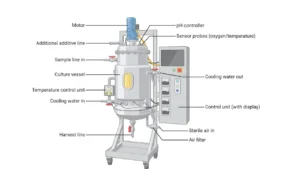
Fermentor Diagram
A typical fermentor diagram illustrates the internal arrangement of all major components inside a bioreactor. Although the exact configuration may vary depending on the application, most industrial fermentors contain a motor, agitator shaft, impellers, sparger, baffles, temperature probe, pH sensor, dissolved oxygen sensor, foam sensor, sampling valve, feed inlet, harvest outlet, exhaust filter, cooling jacket, and an automated PLC control panel.
Together, these components create a sterile environment where microorganisms receive continuous nutrients, oxygen, and proper mixing, allowing them to grow efficiently and produce high-quality biological products.
Types of Bioreactor
Different biological processes require different reactor designs. Therefore, several types of bioreactor have been developed to meet specific industrial requirements. Selecting the right bioreactor depends on factors such as microorganism type, oxygen demand, production capacity, and process complexity.
Stirred Tank Bioreactor
The Stirred Tank Bioreactor is the most widely used reactor in pharmaceutical, biotechnology, and fermentation industries. It uses mechanical impellers to provide excellent mixing and oxygen transfer throughout the culture medium. Because of its high efficiency and precise process control, it is commonly used for manufacturing antibiotics, enzymes, vaccines, amino acids, probiotics, and biofertilizers.
Its robust construction, ease of automation, and scalability make it the preferred choice for both research laboratories and large-scale industrial production.
Airlift Bioreactor
Unlike stirred tank reactors, an Airlift Bioreactor does not use mechanical agitators. Instead, compressed air creates circulation inside the vessel, ensuring gentle mixing with minimal shear stress. This makes it particularly suitable for delicate mammalian cells, plant cells, and algae cultures where mechanical agitation could damage the cells. The simple design also reduces maintenance requirements and energy consumption.
Bubble Column Bioreactor
A Bubble Column Bioreactor is one of the simplest reactor designs. Air is introduced from the bottom through a sparger, and rising bubbles provide both mixing and oxygen transfer. Since there are no moving mechanical parts inside the vessel, maintenance costs are relatively low. These reactors are commonly used in wastewater treatment, fermentation processes, and certain chemical industries.
Packed Bed Bioreactor
Packed Bed Bioreactors contain solid packing materials on which microorganisms or enzymes remain immobilized. As nutrients pass through the packed bed, biological reactions occur efficiently while minimizing cell loss.
These reactors are widely used in enzyme production, pharmaceutical manufacturing, and specialty biochemical processes.
Fluidized Bed Bioreactor
In Fluidized Bed Bioreactors, small particles remain suspended within the reactor by the upward movement of liquid or gas. This design provides excellent contact between microorganisms and nutrients while improving mass transfer.
Fluidized bed systems are commonly employed in wastewater treatment, biochemical production, and high-cell-density fermentation.
Photobioreactor
Photobioreactors are specially designed for cultivating photosynthetic organisms such as algae and cyanobacteria. Instead of relying only on nutrients, these reactors utilize controlled light exposure to support photosynthesis.
They play an important role in biofuel production, carbon dioxide capture, nutraceutical manufacturing, and environmental sustainability projects.
Types of Fermentors
Just as there are different types of bioreactor, industries also use various types of fermentors depending on the production process and manufacturing scale.
Laboratory fermentors are designed for research and small-scale experimentation, while pilot-scale fermentors help validate production before commercial manufacturing begins. Industrial fermentors are large-capacity systems used for continuous production of pharmaceuticals, enzymes, biofertilizers, probiotics, and other biological products.
Based on operating methods, fermentors are further classified as batch fermentors, fed-batch fermentors, and continuous fermentors. Batch systems are suitable for fixed production cycles, fed-batch systems allow nutrient addition during fermentation to increase yield, while continuous fermentors enable uninterrupted production for large-scale industrial applications.
Each fermentor type offers unique advantages, and selecting the appropriate system depends on production objectives, microorganism characteristics, and desired productivity.
Read More: Difference Between Bioreactor and Fermentor
Industrial Uses of Bioreactors
- Pharmaceutical manufacturing (antibiotics, vaccines, insulin, and therapeutic proteins)
- Biotechnology research and commercial production
- Enzyme and industrial enzyme production
- Probiotic and fermented food manufacturing
- Biofertilizer and biopesticide production
- Biofuel production (ethanol and bioethanol)
- Monoclonal antibody and recombinant protein production
- Mammalian, plant, and microbial cell culture
- Tissue engineering and stem cell research
- Wastewater treatment and environmental bioprocessing
Advantages of Modern Bioreactors
- Precise control of temperature, pH, and dissolved oxygen
- High production efficiency and product yield
- Uniform mixing and efficient oxygen transfer
- Reduced risk of contamination with CIP/SIP systems
- Fully automated PLC & SCADA process control
- Consistent product quality and batch reproducibility
- Suitable for laboratory, pilot-scale, and industrial production
- Energy-efficient and cost-effective operation
- Easy process monitoring and real-time data logging
- Customizable design to meet specific industrial applications
How to Choose the Right Bioreactor
Selecting the right bioreactor is an important investment that directly influences production efficiency, product quality, and operating costs. Since every biological process has unique requirements, choosing the appropriate system requires careful evaluation of several factors.
The first consideration is the type of organism being cultivated. Bacteria, yeast, fungi, algae, plant cells, and mammalian cells all require different operating conditions. A reactor designed for bacterial fermentation may not be suitable for sensitive mammalian cell cultures.
Production capacity is another critical factor. Laboratory bioreactors are suitable for research and development, while pilot-scale systems help validate production before commercial manufacturing. Industrial bioreactors are designed for continuous large-scale production where reliability and automation become increasingly important.
Automation requirements should also be evaluated carefully. Advanced PLC and SCADA-controlled bioreactors simplify operation, improve accuracy, and reduce labor costs by automatically maintaining critical process parameters.
Material of construction is equally important. High-quality SS316L stainless steel provides superior corrosion resistance, hygienic operation, and long service life, making it the preferred choice for pharmaceutical and biotechnology industries.
Finally, manufacturers should consider after-sales support, spare part availability, customization options, installation assistance, and future scalability before making a purchasing decision.
Working with an experienced manufacturer ensures that the selected bioreactor meets both current production needs and future expansion plans.
Why Choose Fermenter Technologies?
At Fermenter Technologies, we specialize in designing and manufacturing high-performance fermenters and bioreactors for research laboratories, pilot plants, and industrial production facilities. With years of engineering expertise and a commitment to innovation, we provide customized solutions that meet the demanding requirements of biotechnology, pharmaceutical, food processing, agricultural, and fermentation industries.
Our product portfolio includes laboratory bioreactors, pilot-scale bioreactors, production-scale bioreactors, industrial fermenters, and fully customized fermentation systems. Every system is manufactured using premium SS316L stainless steel and incorporates advanced PLC and SCADA automation, ensuring accurate process control, consistent performance, and long service life.
Beyond manufacturing, we provide complete project support, including equipment design, process consultation, installation, commissioning, validation, operator training, and responsive after-sales service. Our focus is not only on supplying equipment but also on helping customers improve productivity, reduce operational costs, and achieve reliable biological production.
Whether you are establishing a new biotechnology facility or expanding an existing production plant, Fermenter Technologies delivers solutions that combine innovation, quality, and long-term reliability.
Frequently Asked Questions (FAQs)
What is the main purpose of a bioreactor?
A bioreactor provides a controlled environment where microorganisms or cultured cells can grow efficiently to produce biological products such as antibiotics, vaccines, enzymes, biofertilizers, probiotics, and biofuels.
What is the difference between a fermenter and a bioreactor?
A fermenter is mainly designed for microbial fermentation involving bacteria, fungi, and yeast. A bioreactor is a broader system that can support fermentation as well as mammalian cell culture, tissue engineering, vaccine production, and other advanced biological processes.
Which industries use bioreactors?
Bioreactors are widely used in pharmaceutical, biotechnology, food processing, agriculture, biofuel production, environmental engineering, and research laboratories.
Which material is commonly used for industrial bioreactors?
Most industrial bioreactors are manufactured using SS316L stainless steel because of its excellent corrosion resistance, hygienic properties, durability, and compliance with pharmaceutical manufacturing standards.
Can a bioreactor be customized?
Yes. Modern bioreactors can be customized according to production capacity, automation level, process requirements, agitation system, aeration design, and industry-specific applications.
Conclusion
Bioreactors have become the foundation of modern biotechnology and industrial fermentation, enabling the safe and efficient production of a wide range of biological products. Understanding the bioreactor definition, its working principle, bioreactor design, major components, and various types of bioreactor allows manufacturers to select equipment that delivers maximum productivity and consistent product quality. Similarly, learning about what is fermenter, exploring different types of fermentors, and understanding the difference between fermenter and bioreactor helps industries make informed investment decisions for both research and large-scale manufacturing.
As biological manufacturing continues to evolve, the demand for reliable, automated, and scalable fermentation systems will continue to grow. Investing in a high-quality bioreactor not only improves production efficiency but also ensures long-term operational success, regulatory compliance, and reduced manufacturing costs.
At Fermenter Technologies, we are committed to delivering innovative fermenters and bioreactors that meet the highest standards of quality, precision, and performance. Whether your requirement is a laboratory-scale system, a pilot plant, or a fully automated industrial bioreactor, our customized solutions are designed to support your growth and help you achieve consistent, high-quality biological production.