Fermentation is one of the most important processes in biotechnology, pharmaceuticals, food production, and industrial microbiology. While laboratory-scale fermentation helps researchers develop and optimize products, commercial manufacturing requires the process to be expanded to much larger production volumes. This transition from the laboratory to industrial production is known as the scale up of fermentation process. At the same time, industries also use scale down fermentation models to simulate large-scale operations on a smaller scale for research, troubleshooting, and process optimization.
Both fermentation scale up and scale-down strategies are essential for ensuring consistent product quality, higher productivity, and cost-effective manufacturing. Whether producing antibiotics, vaccines, enzymes, biofertilizers, probiotics, or biofuels, successful fermentation depends on choosing the right scale-up and scale-down approach.
In this blog, Fermenter Technologies explains the scale up and scale down process in fermentation, their principles, challenges, methods, and industrial applications.
What is the Scale Up of Fermentation Process?
The scale up of fermentation process is the method of increasing fermentation volume from laboratory or pilot scale to industrial production while maintaining the same biological performance and product quality. The objective is to ensure that microorganisms grow under nearly identical conditions regardless of the reactor size.
A process that performs efficiently in a 5-liter laboratory fermenter may not automatically produce the same results in a 5,000-liter industrial bioreactor. Parameters such as oxygen transfer, agitation, mixing, temperature, and nutrient distribution change significantly as reactor size increases. Therefore, fermentation scale up requires careful engineering and process optimization to achieve consistent results at every stage.
What is Scale Down Fermentation?
Scale down fermentation is the opposite approach. Instead of increasing production volume, it recreates industrial fermentation conditions in a smaller laboratory or pilot-scale bioreactor.
Scientists use the scale down process in fermentation to identify production problems, evaluate new microbial strains, optimize operating conditions, and test process improvements without interrupting commercial manufacturing. Since experiments can be performed quickly and economically, scale-down studies play a crucial role in process development and quality improvement.
Why is Fermentation Scale Up Important?
Modern industries cannot directly transfer a laboratory process to commercial production without proper scale-up. As reactor size increases, physical and biological conditions change considerably. If these changes are ignored, production efficiency, product quality, and process stability may be affected.
A successful fermentation scale up helps industries maintain consistent microbial growth, improve product yield, reduce production costs, minimize contamination risks, and achieve reliable large-scale manufacturing. It also shortens the time required to commercialize new products while ensuring compliance with industrial quality standards.
Principles of Scale Up and Scale Down Process in Fermentation
The scale up and scale down process in fermentation is based on maintaining similar operating conditions across different reactor sizes. Engineers carefully monitor critical process parameters to ensure microorganisms behave similarly in laboratory, pilot, and production-scale systems.
One of the most important factors is oxygen transfer. As reactor volume increases, supplying sufficient oxygen to microorganisms becomes more challenging. Efficient aeration and agitation systems are therefore essential for maintaining microbial activity and product formation.
Mixing efficiency is another critical parameter. Proper mixing ensures nutrients, oxygen, and temperature remain uniformly distributed throughout the fermenter. Poor mixing can create concentration gradients that negatively affect microbial growth.
Temperature control is equally important because fermentation generates heat during microbial metabolism. Industrial bioreactors require advanced cooling systems to remove excess heat and maintain stable operating conditions.
Other important parameters include pH, foam formation, nutrient feeding, pressure, agitation speed, and fermentation time. Maintaining these conditions consistently ensures successful scale-up and reproducible production.
Stages of Fermentation Scale Up
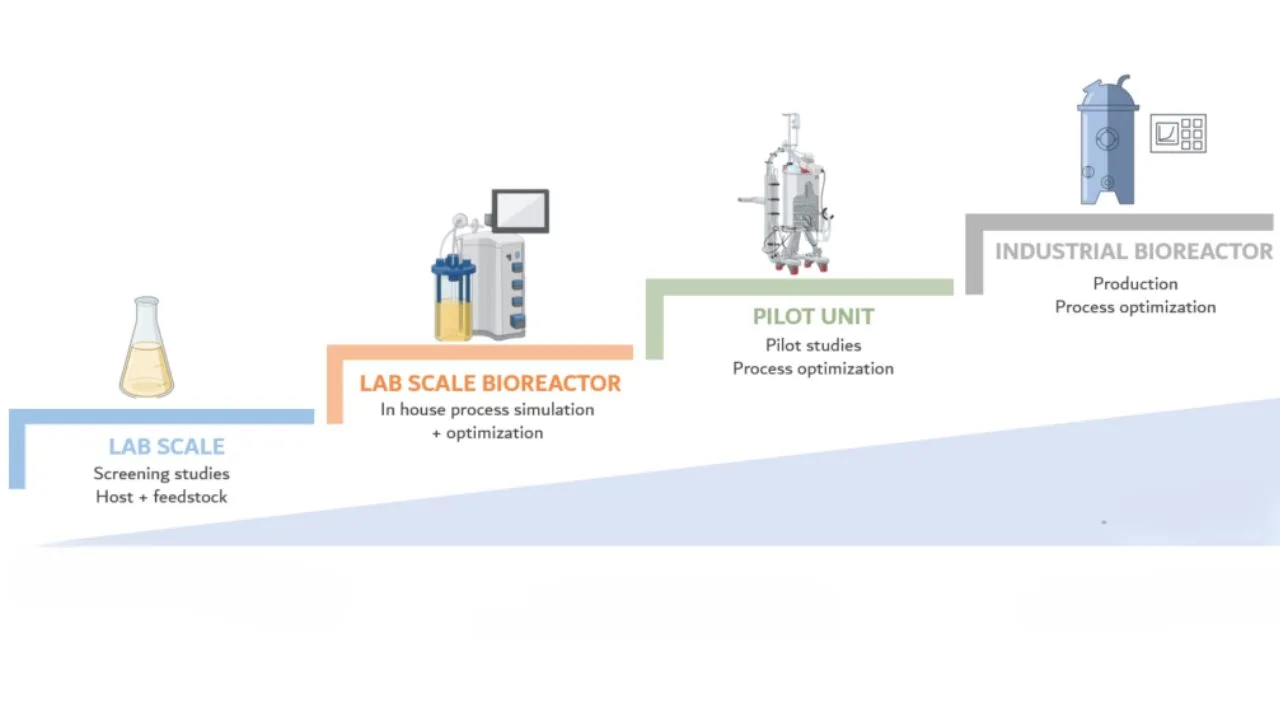
The scale up of fermentation process is usually performed in multiple stages rather than increasing production directly from laboratory to industrial scale.
The first stage begins with laboratory-scale fermenters, where researchers develop microbial strains and optimize process parameters. Once satisfactory results are achieved, the process moves to pilot-scale fermenters. Pilot plants help validate process performance under conditions closer to commercial production while allowing engineers to identify operational challenges.
After successful pilot trials, the process is transferred to industrial fermenters capable of producing large quantities of biological products. This step requires careful monitoring to ensure that laboratory results are successfully replicated in commercial manufacturing.
Scale Down Process in Fermentation
The scale down process in fermentation is equally important because it allows manufacturers to investigate production problems without affecting industrial operations.
Small-scale models are designed to reproduce conditions such as oxygen limitation, nutrient gradients, temperature fluctuations, or mixing inefficiencies that may occur in large fermenters. Engineers can then evaluate corrective actions before implementing them in commercial production.
Scale-down models are commonly used during process development, regulatory validation, troubleshooting, technology transfer, and continuous process improvement.
Challenges in Fermentation Scale Up
Although the concept appears straightforward, fermentation scale up presents several engineering challenges. One of the biggest challenges is maintaining adequate oxygen transfer throughout the reactor. As vessel size increases, oxygen becomes more difficult to distribute uniformly, potentially reducing microbial growth.
Heat removal also becomes increasingly difficult in large fermenters. Without efficient cooling systems, excessive temperatures may damage microorganisms and reduce product yield.
Mixing efficiency is another challenge. Large reactors require carefully designed impellers and baffles to achieve uniform mixing while avoiding excessive shear stress that could damage sensitive cells.
Foam formation, contamination control, sterilization efficiency, and process automation also become more complex as production capacity increases. Addressing these challenges requires advanced bioreactor design and precise process control.
Industrial Applications of Scale Up and Scale Down
The scale up and scale down process in fermentation is widely used across numerous industries where biological production plays a critical role.
In the pharmaceutical industry, these techniques support the production of antibiotics, vaccines, insulin, monoclonal antibodies, and recombinant proteins. Biotechnology companies use them for enzyme production, microbial cultivation, and cell culture research.
Food manufacturers rely on fermentation scale up to produce probiotics, yeast, dairy cultures, vinegar, and fermented beverages. Agricultural industries use scaled fermentation systems for manufacturing biofertilizers, biopesticides, and microbial inoculants.
Biofuel companies apply these methods during ethanol and bioethanol production, while environmental industries utilize fermentation processes for wastewater treatment and bioremediation.
Best Practices for Successful Fermentation Scale Up
Successful scale up of fermentation process requires a systematic approach rather than simply increasing reactor volume.
Manufacturers should begin with a well-characterized laboratory process and gradually progress through pilot-scale validation before industrial production. Advanced sensors should continuously monitor temperature, pH, dissolved oxygen, agitation speed, and foam formation.
Using automated PLC and SCADA control systems improves process consistency while reducing human error. Regular sampling, microbial analysis, and process validation further ensure stable production.
Collaborating with experienced bioreactor manufacturers also helps industries design customized systems that meet their specific production requirements.
Why Choose Fermenter Technologies?
At Fermenter Technologies, we specialize in manufacturing advanced fermenters and bioreactors that support efficient fermentation scale up from laboratory research to full-scale industrial production. Our systems are designed using high-quality SS316L stainless steel and equipped with intelligent PLC and SCADA automation for precise process control.
We offer laboratory fermenters, pilot-scale fermenters, industrial bioreactors, and customized fermentation systems tailored to the needs of pharmaceutical, biotechnology, food, agricultural, and biofuel industries. Our engineering expertise helps customers achieve reliable scale-up, improved productivity, and consistent product quality while reducing operational costs.
Whether you are developing a new fermentation process or expanding existing production capacity, Fermenter Technologies provides complete solutions backed by technical expertise and dependable after-sales support.
Conclusion
The scale up and scale down process in fermentation forms the backbone of successful industrial biotechnology. While the scale up of fermentation process enables manufacturers to move efficiently from laboratory research to commercial production, scale down fermentation provides a practical way to optimize processes, troubleshoot problems, and improve productivity without disrupting large-scale operations.
Understanding the principles, challenges, and applications of fermentation scale up allows industries to achieve consistent product quality, higher production efficiency, and cost-effective manufacturing. By investing in advanced fermenters, intelligent automation, and expert engineering support, businesses can successfully scale biological production while maintaining reliability and regulatory compliance.
At Fermenter Technologies, we are committed to delivering innovative fermentation solutions that help industries bridge the gap between research and commercial success. Our customized fermenters and bioreactors are engineered to support every stage of fermentation, ensuring efficient, scalable, and sustainable biological production for the future.